Basketball explained
The five basketball positions explained, with real player data
Point guard, shooting guard, small forward, power forward and center: what each position does, how the jobs are changing, and measured averages for height and skills from 364 players.
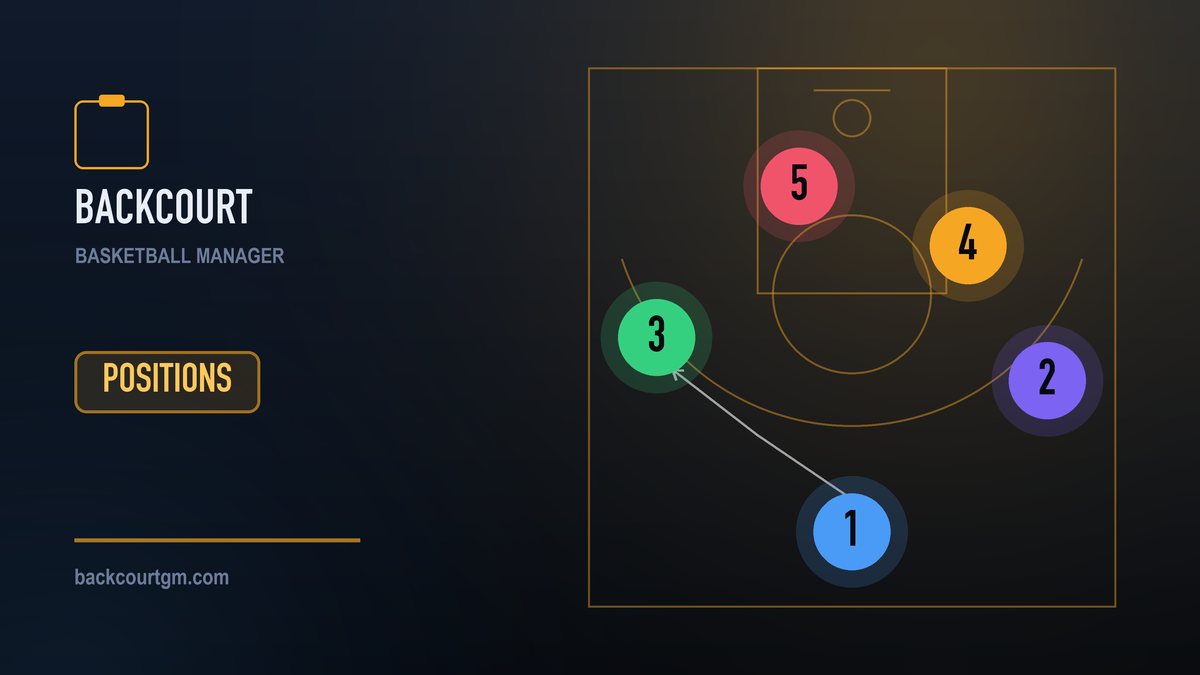
Basketball has five positions, numbered one to five: point guard, shooting guard, small forward, power forward and center. Coaches still use the numbers, broadcasters still use the names, and the modern game keeps blurring the lines between them.
This guide explains what each position does and how the jobs are changing, then adds something most guides cannot: measured averages for height, wingspan and skills at every position, taken from the 364 players in Backcourt Basketball Manager's 2025-26 player pool.
The five positions at a glance
| # | Position | Also called | Main job | Average height | Top-rated in Backcourt |
|---|---|---|---|---|---|
| 1 | Point guard | The one, lead guard | Brings the ball up and runs the offense | 192 cm (6′4″) | Shai Gilgeous-Alexander (94) |
| 2 | Shooting guard | The two, off guard | Scores from the perimeter | 196 cm (6′5″) | Devin Booker (89) |
| 3 | Small forward | The three, wing | Does a bit of everything on the wing | 201 cm (6′7″) | Jayson Tatum (90) |
| 4 | Power forward | The four | Rebounds, defends inside, scores in the post or stretches the floor | 205 cm (6′9″) | Giannis Antetokounmpo (93) |
| 5 | Center | The five, big man | Protects the rim, rebounds and finishes near the basket | 210 cm (6′11″) | Nikola Jokić (94) |
About the numbers. Heights and wingspans come from the 333 players with a listed height. Skills are Backcourt's own in-game ratings, derived from public season statistics. They describe the players in the game's pool, not every professional player.
Point guard (1)
The point guard is the team's primary ball handler and organiser. He brings the ball up the floor, calls the play and decides who shoots. The best point guards either create for teammates or create for themselves so well that the defense has to collapse on them.
On defense the point guard picks up the ball first and fights through screens. The position rewards speed, passing, ball handling and decision-making more than height, which is why smaller players have always thrived there.
By the numbers
Across the 81 point guards in Backcourt's pool, the average height is 192 cm (6′4″) and the average wingspan 202 cm (6′8″). Their strongest attributes are speed (74) and passing (73); the weakest is rebounding (55).
Roles in Backcourt: Floor general or Scorer. Highest rated: Shai Gilgeous-Alexander (94), Luka Dončić (93), Cade Cunningham (92). The highest-potential young point guard outside that group is Dylan Harper, 20, rated 79 with a potential of 97. All 81 point guards, ranked →
Shooting guard (2)
The shooting guard is usually the team's main perimeter scorer: shooting off screens and spot-ups, attacking closeouts and scoring off the dribble. He is often the second ball handler, taking pressure off the point guard.
Because he plays on the perimeter at both ends, the shooting guard is also often asked to guard the other team's best perimeter scorer. Shooting, scoring and defensive quickness matter most.
By the numbers
Across the 79 shooting guards in Backcourt's pool, the average height is 196 cm (6′5″) and the average wingspan 205 cm (6′9″). Their strongest attributes are speed (70) and basketball IQ (69); the weakest is rebounding (61).
Roles in Backcourt: Floor general, Scorer, Sharpshooter, 3&D wing or Slasher. Highest rated: Devin Booker (89), Anthony Edwards (88), Donovan Mitchell (88). The highest-potential young shooting guard outside that group is Stephon Castle, 21, rated 80 with a potential of 94. All 79 shooting guards, ranked →
Small forward (3)
The small forward is the wing who does a bit of everything. He needs to score from all three levels — at the rim, from mid-range and from three — defend players both bigger and smaller than him, and rebound more than a guard would.
That versatility shows up in the numbers: no position in Backcourt's pool is more balanced than the small forward.
By the numbers
Across the 77 small forwards in Backcourt's pool, the average height is 201 cm (6′7″) and the average wingspan 212 cm (6′11″). Their strongest attributes are three-point (68) and basketball IQ (66); the weakest is passing (63).
Roles in Backcourt: Scorer, Sharpshooter, 3&D wing, Slasher or Glue guy. Highest rated: Jayson Tatum (90), LeBron James (89), Franz Wagner (87). The highest-potential young small forward outside that group is Cooper Flagg, 19, rated 81 with a potential of 99. All 77 small forwards, ranked →
Power forward (4)
The power forward traditionally played close to the basket: rebounding, defending bigger players, setting screens and scoring in the post. That version still exists, but the modern four is just as likely to be a stretch four who shoots threes and pulls an opposing big away from the rim.
What has not changed is the physical side of the job. Power forwards still rebound, defend the paint alongside the center and absorb contact.
By the numbers
Across the 54 power forwards in Backcourt's pool, the average height is 205 cm (6′9″) and the average wingspan 215 cm (7′1″). Their strongest attributes are rebounding (73) and defense (69); the weakest is speed (62).
Roles in Backcourt: Sharpshooter, Slasher, Glue guy, Stretch big, Post player or Rim protector. Highest rated: Giannis Antetokounmpo (93), Zion Williamson (91), Anthony Davis (89). The highest-potential young power forward outside that group is Collin Murray-Boyles, 20, rated 70 with a potential of 85. All 54 power forwards, ranked →
Center (5)
The center is usually the tallest player on the floor. On defense he protects the rim, blocks and alters shots and controls the defensive glass. On offense he sets screens, rolls to the basket, rebounds misses and finishes close to the hoop.
The modern center has added skills to that list. Some shoot from outside; others run the offense from the high post as a passing hub.
The passing hub is not a fringe idea. Nikola Jokić, the highest-rated center in Backcourt, is rated 96 for passing — well above the point guard average of 73.
By the numbers
Across the 73 centers in Backcourt's pool, the average height is 210 cm (6′11″) and the average wingspan 222 cm (7′3″). Their strongest attributes are rebounding (77) and defense (71); the weakest is speed (53).
Roles in Backcourt: Stretch big, Post player or Rim protector. Highest rated: Nikola Jokić (94), Victor Wembanyama (93), Joel Embiid (92). The highest-potential young center outside that group is Jalen Duren, 22, rated 85 with a potential of 99. All 73 centers, ranked →
Guards, wings and bigs
Positions are also grouped in three looser ways, and you will hear all of them on a broadcast:
- Guards (1 and 2) — the backcourt, who handle the ball and play the perimeter. See what the backcourt is.
- Wings (2 and 3) — perimeter players with size, who shoot, attack and defend on the flanks.
- Bigs (4 and 5) — the players who rebound, defend the paint and finish near the basket.
Positionless basketball
Watch a modern game and the numbers start to wobble. Centers bring the ball up after a rebound, forwards run the offense and guards crash the glass. Coaches call this positionless basketball: players are defined by what they can do rather than by a number.
A few terms you will hear:
- Combo guard — a guard who can play either the 1 or the 2, scoring as well as running the offense.
- Point forward — a forward who handles and passes like a point guard.
- Stretch four — a power forward who shoots threes, pulling a defender away from the basket.
- Small-ball five — a smaller, quicker player used at center to add speed and shooting.
Positions have not disappeared. They still describe size and who guards whom. What has changed is that a position tells you less about the job, which is why roles have become the more useful description.
What the numbers show
Put the five positions side by side and the job descriptions above turn into measurable patterns.
| Position | Average height | Median height | Average wingspan | Average weight |
|---|---|---|---|---|
| Point guard | 192 cm (6′4″) | 191 cm (6′3″) | 202 cm (6′8″) | 88 kg (194 lb) |
| Shooting guard | 196 cm (6′5″) | 196 cm (6′5″) | 205 cm (6′9″) | 93 kg (205 lb) |
| Small forward | 201 cm (6′7″) | 201 cm (6′7″) | 212 cm (6′11″) | 98 kg (216 lb) |
| Power forward | 205 cm (6′9″) | 203 cm (6′8″) | 215 cm (7′1″) | 102 kg (225 lb) |
| Center | 210 cm (6′11″) | 211 cm (6′11″) | 222 cm (7′3″) | 110 kg (243 lb) |
| Position | Inside | Mid-range | 3PT | Passing | Rebound | Defense | Speed | IQ |
|---|---|---|---|---|---|---|---|---|
| Point guard | 60 | 63 | 69 | 73 | 55 | 61 | 74 | 70 |
| Shooting guard | 65 | 68 | 69 | 69 | 61 | 63 | 70 | 69 |
| Small forward | 64 | 66 | 68 | 63 | 65 | 65 | 66 | 66 |
| Power forward | 68 | 66 | 65 | 62 | 73 | 69 | 62 | 63 |
| Center | 71 | 63 | 55 | 58 | 77 | 71 | 53 | 58 |
Bold marks the position with the highest average for each skill.
- Height climbs 18 cm from point guard to center: 192 cm (6′4″) for point guards up to 210 cm (6′11″) for centers.
- Speed and rebounding trade places. Point guards average 74 for speed and 55 for rebounding; centers average 53 and 77.
- Shooting lives on the perimeter. Three-point ratings average 69 for point guards and fall to 55 for centers.
- Small forwards are the most balanced position: their average skill ratings span only 5 points, from 63 to 68.
- Wingspan outgrows height everywhere. Every position averages a wingspan 9 to 12 cm longer than its height.
Positions in Backcourt
Backcourt keeps positions and adds roles on top. A player's position decides which roles he can play; his attributes decide how well he fits each one, and a player in the right role performs better. Player roles explained covers how the game grades that fit.
| Position | Roles he can play | Most common best role |
|---|---|---|
| Point guard | Floor general, Scorer | Floor general |
| Shooting guard | Floor general, Scorer, Sharpshooter, 3&D wing, Slasher | Floor general |
| Small forward | Scorer, Sharpshooter, 3&D wing, Slasher, Glue guy | Scorer |
| Power forward | Sharpshooter, Slasher, Glue guy, Stretch big, Post player, Rim protector | Rim protector |
| Center | Stretch big, Post player, Rim protector | Rim protector |
Every player in the pool has his own page with ratings, attributes and best role. Start from the point guard, shooting guard, small forward, power forward or center rankings, or browse all 364 players.
The short version
- 1 — point guard: runs the offense. The shortest position, built on speed and passing.
- 2 — shooting guard: the main perimeter scorer and often the best perimeter defender.
- 3 — small forward: the versatile wing who scores, defends and rebounds.
- 4 — power forward: rebounds and defends inside, and increasingly shoots from outside.
- 5 — center: the tallest player, protecting the rim and controlling the glass.
Frequently asked
What are the 5 positions in basketball?
Point guard (1), shooting guard (2), small forward (3), power forward (4) and center (5). The guards play the perimeter, the small forward plays the wing, and the power forward and center are the bigs who play closest to the basket.
Which basketball position is the tallest?
Center. Among the 333 players with a listed height in Backcourt's 2025-26 player pool, centers average 210 cm (6′11″), about 18 cm taller than point guards at 192 cm (6′4″).
What is the best basketball position for a short player?
Point guard. It is the shortest position on average — 192 cm (6′4″) in Backcourt's player pool — and it rewards speed, passing and decision-making more than size.
What is the difference between a point guard and a shooting guard?
The point guard runs the offense and sets up teammates, while the shooting guard is the main perimeter scorer. In Backcourt's ratings point guards average 73 for passing against 69 for shooting guards, and shooting guards are 4 cm taller on average.
What does a small forward do?
A small forward plays on the wing and does a bit of everything: scoring at the rim, from mid-range and from three, defending players of different sizes and rebounding more than a guard. It is often the most versatile position on the floor.
What is positionless basketball?
A style where players are defined by what they can do rather than by a numbered position, such as forwards who run the offense and centers who shoot threes. Positions still describe size and matchups, but roles describe the job.
Try it on your own club tonight
Backcourt is free on iOS and Android. Career mode works offline, and there is nothing to buy that makes your squad stronger.