Basketball explained
What is the backcourt in basketball? The court, the guards and the violations
Backcourt means three things in basketball: half of the floor, a team's two guards, and a pair of violations that give the ball away. Here is each one, with the rules that differ between the NBA, FIBA and college.
Say “backcourt” to three basketball fans and you may get three different answers. It is half of the floor. It is the two guards on a roster. And it is the name of two violations that hand the ball to the other team. The meanings are connected, and all three come up on every broadcast.
Here is each one, with the rules that differ between the NBA, FIBA, college and high school.
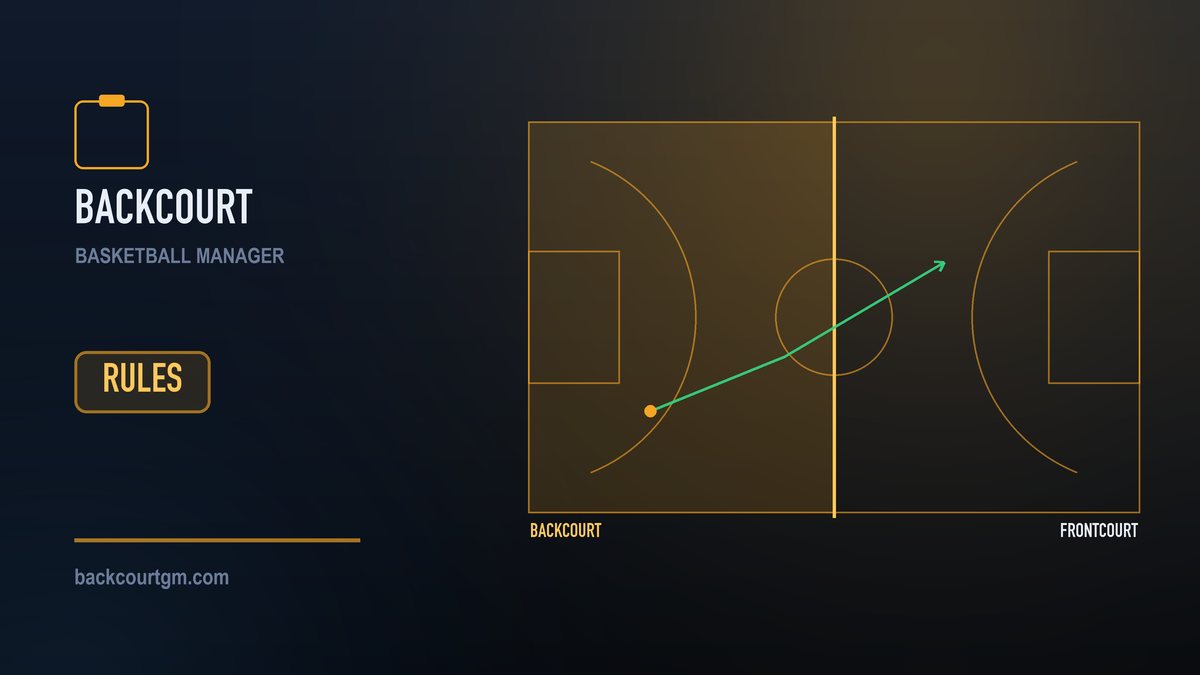
The backcourt is half of the court
The half-court line splits the floor in two. For whichever team has the ball, the backcourt is the half containing the basket it defends, and the frontcourt is the half containing the basket it attacks. Every possession that starts at the defensive end begins with the ball needing to travel from one to the other.
| Backcourt | Frontcourt | |
|---|---|---|
| Which half | Contains the basket the offense defends | Contains the basket the offense attacks |
| The half-court line | Belongs to the backcourt | Starts beyond it |
| When it changes | With every change of possession | Ends swap at halftime |
One detail catches people out: the half-court line itself belongs to the backcourt. A player dribbling up the floor has not reached the frontcourt until both feet and the ball are completely past it.
The backcourt is also your guards
Because the guards are the players who bring the ball up through that half, “backcourt” is also shorthand for them. A team's backcourt is its point guard and shooting guard. Its frontcourt is the small forward, power forward and center.
| Position | Group | Traditional job |
|---|---|---|
| Point guard (PG) | Backcourt | Brings the ball up, runs the offense, creates for others |
| Shooting guard (SG) | Backcourt | Scores from the perimeter, often the second ball handler |
| Small forward (SF) | Frontcourt | Wing scorer and defender who plays inside and out |
| Power forward (PF) | Frontcourt | Rebounds, defends the interior, scores near the basket |
| Center (C) | Frontcourt | Protects the rim, rebounds, anchors the defense |
So when a commentator says a team has “the best backcourt in the league”, they mean its guard pairing, not its half of the floor. Modern positions blur, and plenty of forwards handle the ball, but the word has stuck.
The time rule: 8 seconds or 10
The first backcourt violation is about speed. Once a team gains control of the ball in its backcourt — from a throw-in, a rebound or a steal — it has a fixed number of seconds to get the ball into the frontcourt. Fail, and the ball goes to the other team.
| Level | Time to cross half court |
|---|---|
| NBA | 8 seconds |
| FIBA (international) | 8 seconds |
| NCAA (US college) | 10 seconds |
| High school (US) | 10 seconds |
The professional count used to be ten seconds as well. FIBA cut it to eight in 2000 and the NBA followed a season later, part of a wider push to speed the game up. That is why NBA broadcasts talk about the 8-second rule while college games have a 10-second rule.
Pressure is the point. The time limit is what makes a full-court press dangerous. A defense that slows the ball handler for a few seconds in the backcourt is not just delaying the offense — it is running down a clock that ends in a turnover.
The over-and-back violation
The second violation is about direction. Once a team has brought the ball into its frontcourt, it cannot take it back. Officials check three things, and all three must be true:
- The offense had the ball in its frontcourt. The ball must have reached the frontcourt first.
- The offense was the last to touch it before it went back into the backcourt.
- The offense was the first to touch it after it arrived in the backcourt.
If any of the three is missing, there is no violation. The most common reason is the defense: if a defender deflects the ball into the backcourt, the offense can simply go and get it, because the offense was not the last to touch it.
The airborne exception
College and high school rules add a specific allowance. A player who jumps from the frontcourt and secures the ball in the air — on a jump ball, on a throw-in, or as a defender gaining possession — may land in the backcourt without committing a violation. It exists so that a player making a clean play is not punished for where their momentum carries them.
The quick test. Who touched it last in the frontcourt, and who touched it first in the backcourt? If the answer to both is the offense, it is over and back. If the defense appears in either answer, play on.
What happens after a backcourt violation
Both kinds are violations, not fouls. Nobody goes to the free-throw line and nobody is charged with a personal foul. The offense simply loses the ball and the other team inbounds it. It goes in the box score as a turnover, which is exactly why coaches hate it: a possession given away without a shot.
The backcourt in Backcourt Basketball Manager
In Backcourt the guards are where a roster's offense is organised, and the role system makes that explicit. A point guard can play Floor general or Scorer. A shooting guard has the widest choice of any position: Floor general, Scorer, Sharpshooter, 3&D wing or Slasher.
The Floor general role can only be given to a guard, and the game's squad-balance check warns you when nobody on the roster plays it. In other words, you cannot build a balanced team in Backcourt without at least one guard who runs the offense — the real-world idea of a strong backcourt, turned into a rule.
Here are the strongest guard pairings in the current player pool, grouped by each player's real-world team and ranked by the average rating of the best point guard and the best shooting guard:
| Team | Point guard | Shooting guard | Average |
|---|---|---|---|
| Minnesota Timberwolves | LaMelo Ball (91) | Anthony Edwards (88) | 89.5 |
| Los Angeles Lakers | Luka Dončić (93) | Austin Reaves (85) | 89.0 |
| Cleveland Cavaliers | James Harden (87) | Donovan Mitchell (88) | 87.5 |
| Philadelphia 76ers | Tyrese Maxey (87) | Jaylen Brown (83) | 85.0 |
| New York Knicks | Jalen Brunson (89) | Josh Hart (77) | 83.0 |
| San Antonio Spurs | De'Aaron Fox (86) | Stephon Castle (80) | 83.0 |
Every name links to that player's ratings, attributes and best role. For the full lists, see the best point guards and the best shooting guards, and for how roles work over a season, the player roles guide.
The short version
- The backcourt is the half of the floor a team defends, and the half-court line belongs to it.
- The backcourt is also the guards: the point guard and the shooting guard.
- The time rule is 8 seconds in the NBA and FIBA, and 10 in college and high school.
- Over and back needs the offense to touch the ball last in the frontcourt and first in the backcourt. A defensive deflection cancels it.
- Both are violations, not fouls: the penalty is losing the ball.
Frequently asked
What does backcourt mean in basketball?
The backcourt is the half of the court containing the basket a team defends, which is the half it has to bring the ball out of at the start of a possession. The word also means a team's guards, the point guard and shooting guard, because they are the players who bring the ball up through it.
What is a backcourt violation?
There are two. A time violation happens when a team fails to get the ball past the half-court line in time: 8 seconds in the NBA and FIBA, 10 seconds in NCAA and high school basketball. An over-and-back violation happens when a team that has brought the ball into its frontcourt sends it back and is the first to touch it there.
Is it 8 seconds or 10 seconds to cross half court?
It depends on the level. FIBA reduced the limit from 10 seconds to 8 in 2000 and the NBA followed a season later, so professional games use 8 seconds. NCAA and high school games use 10 seconds.
What is the penalty for a backcourt violation?
The offense loses the ball and the other team inbounds it. It is a violation rather than a foul, so there are no free throws and no personal foul is charged. It counts as a turnover.
Who plays in the backcourt?
The point guard and the shooting guard. Together they are a team's backcourt, while the small forward, power forward and center make up the frontcourt.
Try it on your own club tonight
Backcourt is free on iOS and Android. Career mode works offline, and there is nothing to buy that makes your squad stronger.