Basketball explained
Zone or man-to-man: what each defensive setting actually does
Zone seals the paint and hands the opposition more three-point attempts. Pressure forces turnovers and gets broken for layups. What each defensive setting really costs, in numbers.
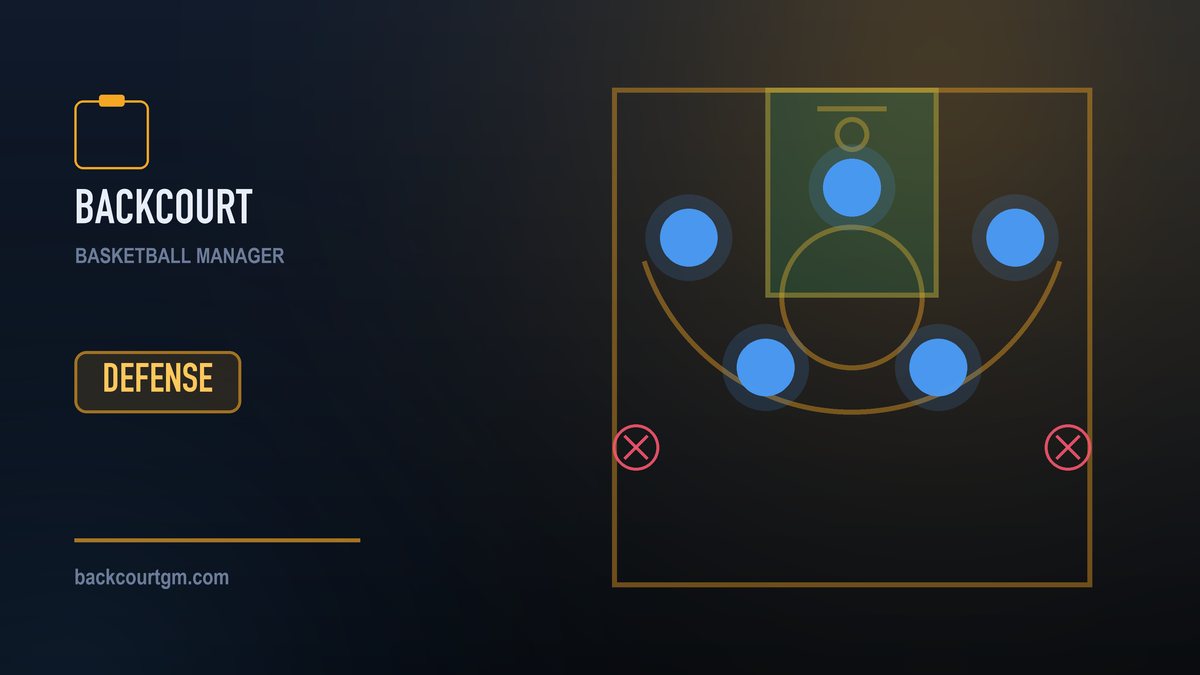
Defence is the half of a tactics screen most managers set once and never revisit. It is also where the largest free gains in a season are, because the settings are genuine trade-offs rather than upgrades: every one of them gives something up.
What you actually control
Backcourt gives you three defensive levers, plus per-player instructions:
- Scheme — man-to-man or zone.
- Defensive pressure — from contain to aggressive.
- Help defence — from stay home to rotate.
Real coaches work a level below this, choosing a coverage for each ball screen. The game works a level above it, and the trade-offs turn out to be the same ones.
Zone, in numbers
Switching to zone changes four things at once:
| What changes | Direction |
|---|---|
| Share of opponent shots taken from three | Up by about five percentage points |
| Contest on shots in the paint | Tighter by a few percent |
| Contest on three-point shots | Looser by a few percent |
| Turnovers you force | Down by about two percentage points |
So zone is a bet: you accept more three-point attempts, defended slightly worse, in exchange for a sealed paint and a defence that screens cannot pull apart. Against a team that cannot shoot, that is close to free. Against a team that can, you are handing them their best shot and making it easier.
The remarkable thing is how closely that mirrors the real league. When tracking data compared NBA zone possessions with man-to-man, points per possession came out nearly identical — but the shot mix flipped hard: over half of the shots against zone came from three, against roughly 38% versus man, while shots at the rim fell from about a quarter to one in six. Zone does not stop offence. It redirects it.
Pressure: the fastest way to win or lose a game
Aggressive pressure tightens your perimeter defence and forces more mistakes. The bill arrives when it gets broken: in Backcourt a fast lineup gains up to about five percentage points on shots at the rim against heavy pressure, which is the sim's version of the thing every coach fears — a press beaten for a layup.
The real league is currently rediscovering exactly this trade. Pressing has roughly doubled in two seasons, and defences picked the ball up in the backcourt on more possessions than at any point in thirteen seasons of tracking, with turnovers rising alongside. Teams are paying the transition risk on purpose, because the turnovers are worth more.
The other cost is one a sim can measure better than television can: energy. Pressure is a season-long expense, not a per-game one — see the energy guide for what it does to your rotation by February.
Help defence: paint or arc, pick one
Rotating help stiffens the paint. Staying home keeps shooters covered. You cannot have both, and the clearest proof in modern basketball is Milwaukee's drop-coverage defence: the best rim protection in the league and, simultaneously, dead last at preventing opponent three-point attempts. It worked until a playoff opponent decided to shoot every one of those threes.
The mirror image is switching everything. Houston's small-ball team switched more than anyone and finished last in the league at defensive rebounding — because a switching defence is constantly guarding the wrong-sized player when the shot goes up. In Backcourt that same tension is visible in the rebounding weighting: the best rebounder on the floor collects far more than his share, so a lineup without one leaks second chances.
The real coverages, and why they are not settings
If you want to follow a broadcast properly, these are the four names you will hear, all of them decisions about one screen:
| Coverage | What it protects | What it gives up |
|---|---|---|
| Drop | The rim and the roll | Pull-up jumpers and floaters |
| Switch | Removes the screen's advantage entirely | Mismatches, and rebounding |
| Blitz / trap | Takes the ball out of a star's hands | Four-on-three behind it |
| Ice / down | The middle of the floor | Baseline drives, and the pop |
Backcourt does not ask you to choose between them. It asks the question one level up — how much help, how much pressure, man or zone — and resolves the rest inside the match engine. Worth knowing the vocabulary anyway: it is the same set of trade-offs, and it makes the play-by-play feed considerably easier to read.
Why the NBA lets you play zone at all
It did not, for over fifty years. The league's tangled illegal defense rules existed to preserve one-on-one basketball, and they were abolished in April 2001, effective from 2001-02. In their place came the defensive three-second rule: a defender in the lane must be actively guarding someone — within arm's length, in a guarding position — or leave, with a technical foul as the penalty. That single rule is why NBA zones look stretched compared with college ones, and why FIBA and college teams can pack the paint in ways an NBA team cannot.
A defensive routine that takes ten seconds a week
- Check the opponent's three-point volume. High volume: man-to-man. Low volume: zone is free value.
- Check who your best defenders are. Bigs point toward zone and rotating help; quick guards point toward man-to-man and pressure.
- Only press when you need turnovers — chasing a game, or against a slow opponent. Never as a default in a heavy fixture week.
- Re-check in the playoffs. A good opponent will attack whichever concession you have chosen, and a seven-game series gives them time to do it.
The offensive half of the same screen — pace, three-point emphasis, crashing the glass and the late-game plan — is covered in the tactics guide.
Frequently asked
What is the difference between zone and man-to-man defence?
In man-to-man each defender is responsible for an opponent and follows him. In a zone each defender is responsible for an area. Zone protects the paint and is harder to screen, but it concedes perimeter shots and rebounds worse, because nobody has a man to block out.
What does the zone setting do in Backcourt?
Three things at once. Opponents take a noticeably larger share of their shots from three, your paint defence tightens by a few percent, your perimeter defence loosens by about the same, and you force roughly two percentage points fewer turnovers. It is a trade, not an upgrade.
When should I play zone?
Against teams that cannot shoot from distance, and when your best defenders are your big men. Zone hands the opposition more three-point attempts by design, so against a high-volume shooting team you are handing them the shot they want.
What does defensive pressure change?
Aggressive pressure tightens perimeter defence and forces more mistakes, but it gives fast opponents a real edge at the rim when they break it — in Backcourt a quick lineup gains up to about five percentage points on inside shots against heavy pressure. It also costs energy across a season.
Why is zone legal in the NBA now?
The league's illegal defense rules were scrapped in April 2001, effective from the 2001-02 season, and a defensive three-second rule was added at the same time to stop defenders camping in the lane. FIBA and college basketball have never had that restriction, which is why zone is more common there.
Does Backcourt model drop coverage or switching?
No. Real coaches choose between drop, switch, blitz and ice on individual ball screens; Backcourt works at the level above that — scheme, pressure and help defence, plus per-player instructions. The trade-offs are the same ones, expressed as sliders rather than coverages.
Try it on your own club tonight
Backcourt is free on iOS and Android. Career mode works offline, and there is nothing to buy that makes your squad stronger.