Strategy guide
How to rebuild a team in a basketball GM game
Most managers start their rebuild a season too late. How to tell whether to contend, retool or rebuild, how to run a rebuild in five steps, and why the real NBA just made bottoming out a worse bet.
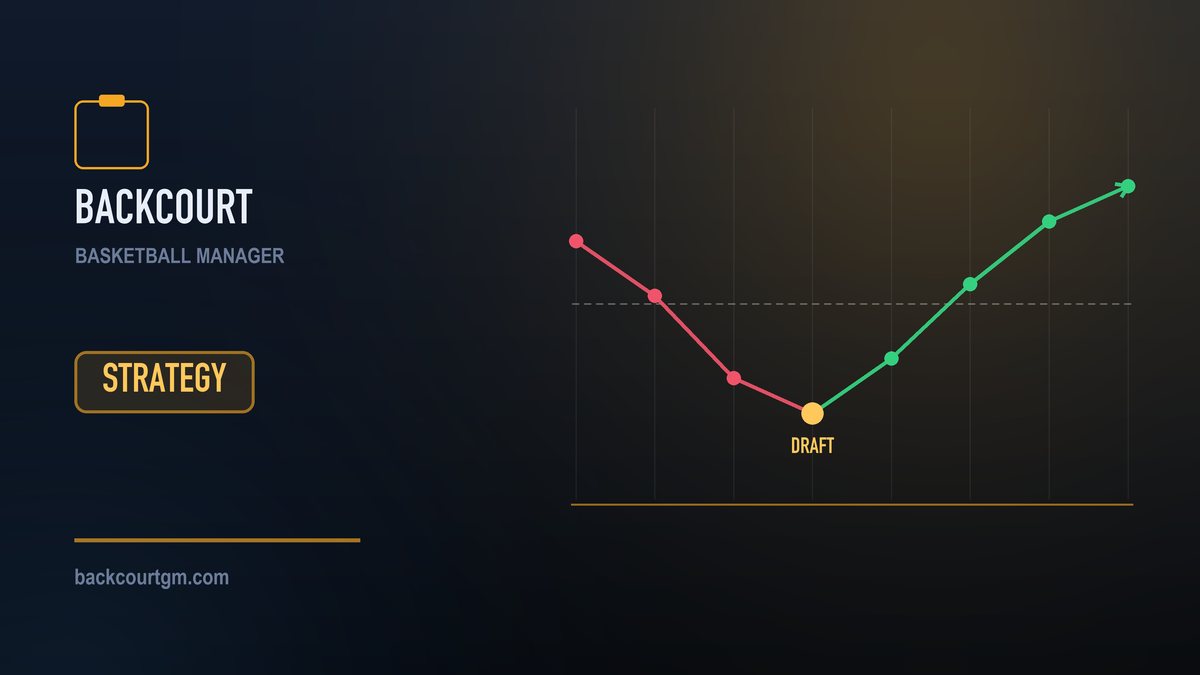
Every long career in a basketball GM game reaches the same moment. Your best player turns thirty-one, his contract is the biggest on the books, and the club that was a contender two seasons ago is fighting for the last playoff place. You can push for one more run, or you can take the team apart and start again.
Most managers get this decision wrong in the same direction: they wait too long. This guide covers how to tell which path your club is on, how to run a rebuild in five steps, what tanking really costs, and why the real NBA has just made bottoming out a worse bet.
The principles apply to any basketball GM game. Where Backcourt has a specific system, we say so.
Contend, retool or rebuild?
There are three honest options, and five signals tell you which one you are in.
| Signal | Contend | Retool | Rebuild |
|---|---|---|---|
| Best player | Under 30 and at his peak | One star still under 30 | Over 30, or no star at all |
| Supporting cast | Several good players around him | Good pieces, poor fit or bad money | Old, expensive or both |
| Salary cap | Money tied to players who win | Some contracts you regret | Big money on declining players |
| Draft picks | Spent, or ready to spend | A few left | Few, or already traded away |
| Standings | Top of the conference | Play-In range | Near the bottom |
If most of your answers land in one column, that is your path. If they are split, you are probably a retool.
The middle is the worst place to be
A club that finishes eighth every season feels respectable and goes nowhere. It is too good for a high pick and not good enough to win a title, and it spends its money keeping together a roster that has already peaked.
In Backcourt the middle has a name. Seeds 7 to 10 in each conference play the Play-In for the last two playoff places, so a club that settles there spends every spring in elimination games for the right to be a heavy underdog.
The question to ask. Not “can we make the playoffs?” but “can this roster win a title within two seasons?” If the honest answer is no, every season spent in the middle costs you a year of a rebuild you will have to do anyway.
Retool before you rebuild
A full rebuild is not the only alternative to contending. If you still have one genuine star under thirty, a retool is usually faster:
- Keep the star and build the next core around his timeline.
- Move the bad money — long contracts on players who are declining or not playing.
- Add young role players who will improve while the star is still at his peak.
Rebuild fully only when there is nobody you would build around, or when that player is the one whose contract is sinking you.
How to run a rebuild in five steps
1. Sell veterans while they still have value
The best time to sell a thirty-year-old is the season before everyone agrees he is declining. Age and contract length push asking prices around, so a veteran on an expiring deal is often your easiest sale — the transfer market guide explains how value and asking price work.
In Backcourt the week-26 trade deadline is a natural sale window: offers arrive back to back on a 45-second clock, and then trades close for the season.
2. Clear the cap
Let expiring contracts run out instead of renewing out of habit, and never extend a peak-money deal into a player's decline. Backcourt settles renewals at an end-of-season renewal desk, with contract talks run against the salary cap, and players in their final contract year are badged in the squad list. The salary cap guide covers the contracts that sink clubs.
3. Collect picks and prospects
Draft picks are currency. In Backcourt they sit on the trade desk alongside players and salary matching, so a veteran can become a pick now and the pick can become a player later, when you are ready to buy. Treat a prospect's potential as a range rather than a promise — the draft and scouting guide covers reading those ranges and when a scouting report is worth paying for.
4. Develop and evaluate young players
A lost season is the cheapest time in a career to give young players real minutes, because there is no playoff race to protect. In Backcourt, minutes on their own do not develop a player: improvement comes from weekly training, drill mini-games and off-season growth, fastest when a player is young and well below his potential. What minutes in a season that does not matter do is show you who can actually play before you commit money to them. The gym speeds up every training week, and the academy is one of six upgradeable facilities — the natural upgrade for a club building through youth.
5. Know when to switch back
A rebuild is a phase, not an identity. Start buying again when you have:
- Two players you would build around, young enough to improve together.
- Cap room that is no longer committed to anyone from the old core.
- More picks than roster spots to use them on — a surplus is for trading, not hoarding.
The classic mistake here is collecting assets for one season too many, and letting the young core's cheap years run out before the team is ever good.
What tanking really costs
Rebuilding and tanking are not the same thing. A rebuild accepts losses as the price of trading veterans for picks, prospects and cap room. Tanking makes losing the goal. In a GM game that difference has real costs:
- Your job. Backcourt tracks club mood for the board, the fans and the locker room, and its coaching market includes sackings. A season spent losing on purpose is a season spent testing the board's patience.
- The locker room. Players knock on Backcourt's Locker-Room Door with demands about minutes, morale and leaving, so a rebuild that sidelines veterans still has a room to manage.
- The lottery is not a guarantee. Backcourt draws its lottery ball by ball on draft night, with the odds and pick changes shown as they land. Plan for a range of picks, never for the first one.
The real NBA just made tanking a worse bet
Real leagues keep redesigning the lottery for exactly this reason. On May 28, 2026 the NBA Board of Governors approved the 3-2-1 Lottery, by a 29–1 vote according to ESPN. It takes effect from the 2027 draft and runs for the 2027, 2028 and 2029 drafts.
| Lottery balls | Who gets them |
|---|---|
| 3 | Teams that miss both the playoffs and the Play-In, except the three worst records |
| 2 | The three worst records, after losing a ball, and the No. 9 and No. 10 Play-In seeds in each conference |
| 1 | The losers of the No. 7 vs No. 8 Play-In games in each conference |
- Sixteen teams are in the lottery, and all sixteen picks are drawn.
- The three worst records are “draft relegated”: they lose a ball and can fall as far as the No. 12 pick. Every other lottery team can fall to No. 16.
- No team's pick can be first overall in two consecutive drafts, or in the top five in three consecutive drafts.
The effect is simple: finishing last is no longer the best route to the top pick. If you play a basketball GM game that follows the real league's rules, check which lottery it uses before you plan a tank around it, because the answer decides whether bottoming out is even the right strategy.
A four-season rebuild plan
| Season | Goal | Moves |
|---|---|---|
| 1 | Sell and clear | Trade veterans with value, let bad contracts expire, collect picks |
| 2 | Draft and develop | Use your picks, give young players real minutes, scout the next class |
| 3 | Add | Spend cap room on players who fit the young core's age |
| 4 | Push | Trade surplus picks for a proven player and aim for the playoffs |
Not every club needs all four. A retool can skip straight to season three, and a club with no picks and no young players may need an extra season in the first two rows.
The short version
- Decide early. The costliest rebuild is the one you start a season too late.
- Avoid the middle. A permanent Play-In club gets neither a title nor a top pick.
- Sell before decline, clear the cap, collect picks, and give young players the minutes.
- Losing is a cost, not a strategy — for your job, your locker room and, in the real NBA from 2027, your lottery odds.
Frequently asked
Should you tank in a basketball GM game?
Rarely on purpose. Rebuilding — trading veterans for picks, prospects and cap room — is almost always better than losing for its own sake, because tanking risks your job, your locker room and a lottery that does not guarantee the top pick. In Backcourt, club mood and a coaching market that includes sackings make deliberate losing a real risk.
How long does a rebuild take?
Plan for two to four seasons: one to sell veterans and clear the cap, one or two to draft and develop, and one to add proven players around the young core. A retool that keeps a star under thirty can be quicker.
When should you trade your star in a rebuild?
When he will be past his peak by the time your young core is ready, or when his contract is what stops you rebuilding. Sell a season before his decline is obvious, while other clubs still pay for what he is now.
Are draft picks worth more than players?
Not in themselves. Picks are useful because they are cheap, flexible and tradeable, but a pick is an uncertain prospect while a player is a known quantity. Collect picks while you rebuild and spend the surplus once you are ready to contend.
Can losing get you fired in Backcourt?
It can put your job at risk. Backcourt tracks club mood for the board, fans and locker room, and its coaching market includes sackings, offers and resignations, so a deliberately bad season is not free.
What is the NBA's new 3-2-1 draft lottery?
A format the NBA Board of Governors approved on May 28, 2026 for the 2027 to 2029 drafts. It expands the lottery to 16 teams, gives three balls to teams that miss both the playoffs and the Play-In, and takes one away from the three worst records, who can fall as far as the 12th pick.
Try it on your own club tonight
Backcourt is free on iOS and Android. Career mode works offline, and there is nothing to buy that makes your squad stronger.