Systems guide
Player roles explained: rim protector, floor general, glue guy
A role is not a label — it changes what the engine asks of a player and what his rating is measured against. Here is what each one rewards, and how to spot a bad fit.
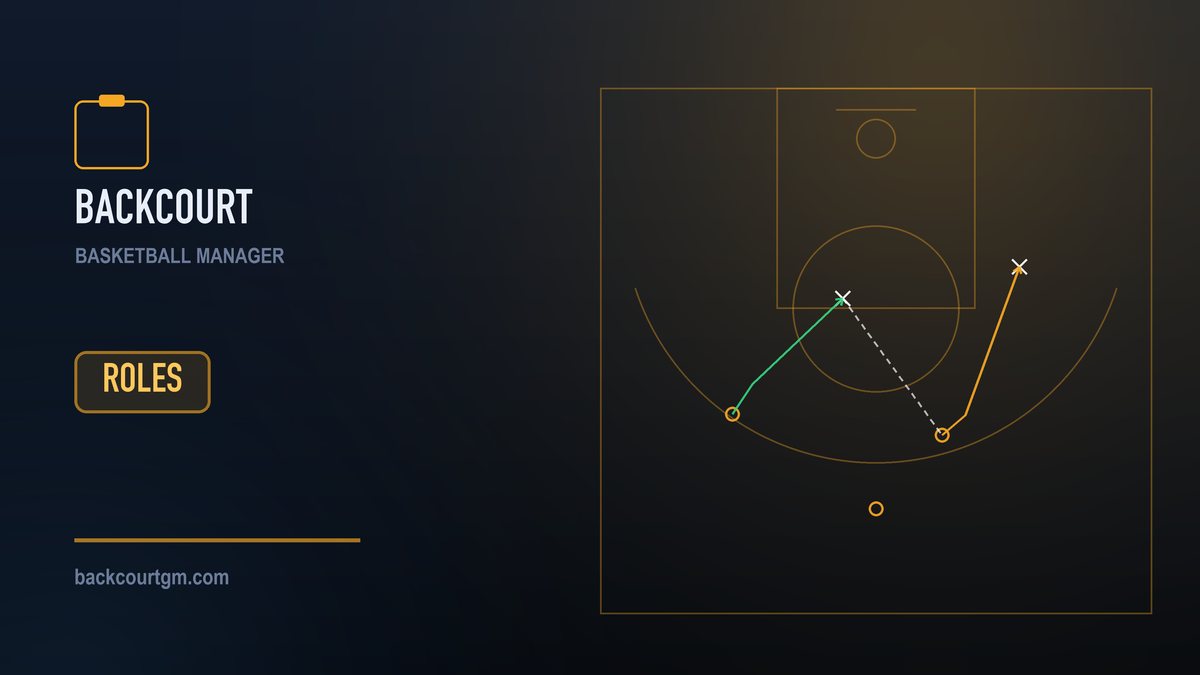
The role dropdown on a player card looks like flavour text. It is not. It is one of the two or three settings in Backcourt that genuinely changes results, and it is the one most managers leave on whatever it defaulted to.
A role does two distinct things:
- It changes what the player does on the court. The engine weights his decisions differently during a possession — where he goes, what he attempts, what he prioritises.
- It changes what he is graded against. The post-game rating measures him against the brief you gave him, not against a generic standard.
Get it right and a 78-rated player produces like an 84. Get it wrong and a 90 looks like a disappointment for twenty straight weeks while you wonder what is wrong with him.
Rim protector
Who it is for: your tallest, strongest interior defenders. Centres, and power forwards with real size.
What it rewards: interior defence, blocks, defensive rebounding, and contesting shots near the basket. A rim protector is judged on what the opposition fails to do, which is why his rating can be excellent on a night he scores eight points.
The trap: giving it to a skilled big man who is actually your best scorer. If your centre is a 97-rated offensive hub, the rim protector brief will underuse him and grade him on a dimension that is not his strength.
Floor general
Who it is for: your primary ball handler. Usually the point guard, occasionally a creative wing.
What it rewards: creation, assists, tempo control and — importantly — low turnovers. This is the one role where a mistake is weighted heavily against you. A floor general with 9 assists and 6 turnovers will grade worse than one with 6 assists and 1 turnover.
The trap: assigning it to a high-scoring guard who is not actually a distributor. He will shoot, which the brief does not reward, and his rating will sit stubbornly around 6 while his points average looks fine.
You only need one. Two floor generals on the court at once do not double your creation — they compete for the same possessions. Give one player the brief and let the other operate under a different role.
Glue guy
Who it is for: high-effort, lower-rated players. This is the role that makes your bench worth having.
What it rewards: the quiet work — positioning, loose balls, hustle rebounds, not making mistakes. Crucially, the glue guy brief has modest expectations, which means a solid night from a 79-rated player under this role produces a genuinely high mark.
Why it matters more than it looks: because ratings feed morale, and morale feeds form. A bench player who is consistently graded well stays in good spirits and keeps producing. Put that same player under a demanding brief he cannot meet and you manufacture a morale problem out of nothing.
How the grading actually works
This is the part worth internalising. Backcourt does not score a performance in a vacuum — it scores it against what the role and the player's quality entitled you to expect.
| Player | Role | Line | Mark | Why |
|---|---|---|---|---|
| 97 OVR star, 38 min | Floor general | 23 pts, 5 ast, 4 TO | ~6.5 | Expected output, and the turnovers hurt under this brief. |
| 95 OVR big, 18 min | Rim protector | 20 pts, 11 reb | ~9.4 | Dominant per-minute production in the exact dimensions the role rewards. |
| 79 OVR bench, 17 min | Glue guy | 4 pts, 8 reb, 1 ast | ~5.1 | Quiet even for a modest brief. |
| 88 OVR wing, 48 min | — | 29 pts, 9 reb | ~6.9 | Big counting stats, but 48 minutes makes them the baseline. |
Notice the fourth row. Heavy minutes raise the expectation. A player who plays the whole game and puts up big numbers has not necessarily had a good night — he has had a long one. This is why the ratings screen is more useful than the box score for deciding who deserves more minutes next week.
Spotting a bad role fit
You do not need to guess. The symptoms are specific:
- A consistently mediocre mark alongside a respectable box score. The clearest signal. He is doing things, but not the things you asked for.
- Morale drifting down on a player who is playing regularly and whose team is winning.
- A high-rated player who never feels decisive in the commentary feed — his name appears, but rarely on the actions that matter.
The fix costs nothing. Open the squad screen, change the role, and watch the next three or four games. There is no penalty for changing a role mid-season and no adjustment period to wait out.
A quick assignment pass
Go down your roster once and ask one question per player: what is this man actually good at?
- Tallest, best interior defender → rim protector.
- Best passer and decision-maker → floor general. One only.
- Best pure scorer → a scoring-weighted role, not floor general.
- Everyone in the bench rotation → glue guy, unless they are clearly something else.
- Anyone with no role assigned → give them one. A blank role is the worst option available.
Five minutes of work, once. It is the cheapest improvement available to a Backcourt squad, and it compounds every single week for the rest of the season — because a well-briefed player produces more, grades higher, keeps his morale, and stays in form.
Roles decide how a player is graded. The nine numbers underneath them, and how much each one counts by position, are in the attributes guide.
Frequently asked
What happens if I give a player the wrong role?
His actual output drops, and he is graded against a brief he cannot meet — so his rating falls even on nights his box score looks fine. Repeated low marks then cost him morale, which compounds the problem.
Can I change a player's role mid-season?
Yes, at any time from the squad screen, and there is no penalty for doing so. If a player has been underperforming for several weeks, changing his role is one of the cheapest fixes available.
Should every player have a role?
Every player in your rotation should. A player with no role assigned is judged against a generic brief, which almost never flatters him.
Does the role affect the match engine or only the rating?
Both. The role changes what the player attempts during a possession, and it changes the standard his performance is measured against afterwards.

Try it on your own club tonight
Backcourt is free on iOS and Android. Career mode works offline, and there is nothing to buy that makes your squad stronger.