Strategy guide
Transfer market strategy: value, asking price and patience
The gap between value and asking price is the whole game. Here is what widens it, when a trade beats a bid, and how to get out of a negative treasury without gutting your squad.
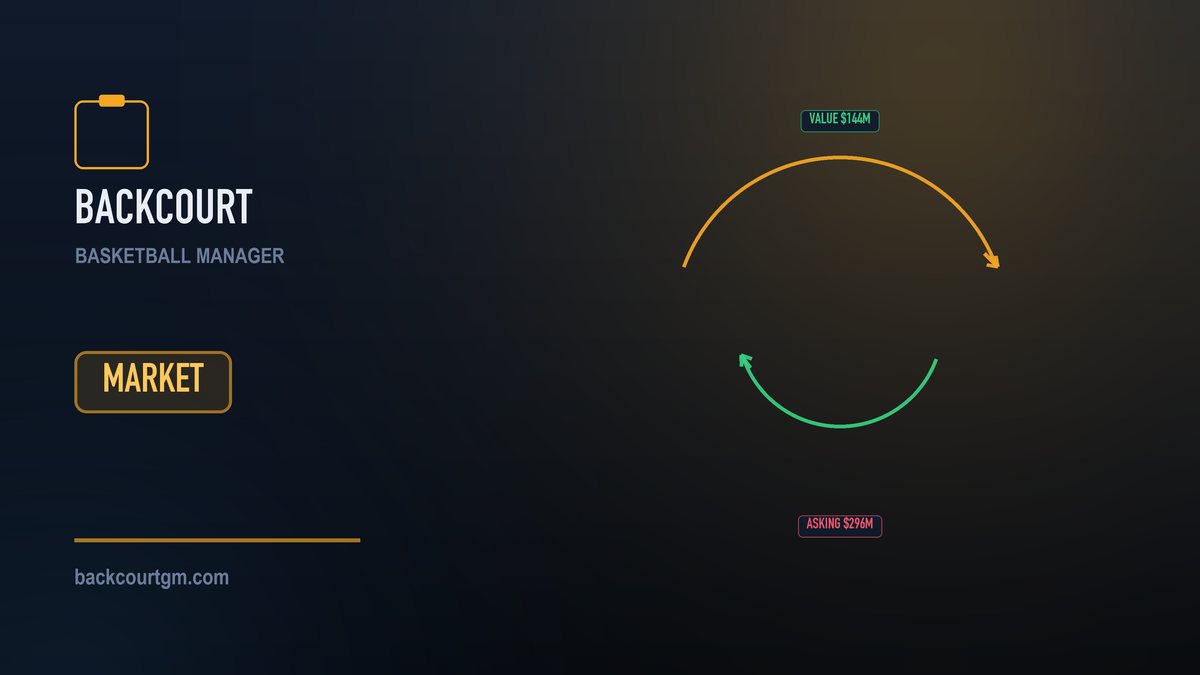
Open the market screen and you will see two numbers on every player card that appear to disagree with each other. A 97-rated forward has a value of $144M and an asking price of $296M. Your treasury says -$8.80M. It is tempting to conclude the market is broken, or that the game simply does not want you to sign anyone good.
Neither is true. That gap is the most informative thing on the screen, and learning to read it is the difference between a squad that improves every summer and one that spends four seasons stuck.
What the two numbers actually mean
Value is the engine's flat estimate of what the player is worth as a footballing asset: quality, age, and what he would command in an open market where everyone is available.
Asking price is what this club, right now will accept to part with him. It is value adjusted by a set of factors that all point in the same direction — reluctance.
| Factor | Effect on asking price | Why |
|---|---|---|
| Young with high potential | Sharply up | The club expects him to be worth far more later. |
| Long contract remaining | Up | No pressure to sell; time is on their side. |
| Central to his club's rotation | Up | Selling him damages their season. |
| On hot form | Up | Price rises with the current run. |
| Aging, contract expiring | Down toward value | The asset is depreciating in their hands. |
| Club out of contention | Down | Nothing left to protect this season. |
So the ratio tells you something specific:
- Asking ≈ value — genuinely available. Move now.
- Asking ≈ 1.3–1.6× value — expensive but real. This is a negotiation.
- Asking > 2× value — the club is telling you he is not for sale. Stop looking at him.
The mistake almost everyone makes. Falling in love with the 97 whose asking price is double his value, and spending three seasons of treasury waiting to afford him — while a 91 at a fair price, available right now, would have won you two of those seasons.
Trades are the tool for a thin treasury
The trade desk has been there since launch, and most managers still under-use it. When your balance is negative, a package is frequently the only route to improving a squad — and draft picks count as currency alongside players and cash.
The engine evaluates a trade differently from a cash bid. It weighs the incoming player's value, age and wage against what it is giving up, and a package that looks fair on those terms will often be accepted where a cash bid of the equivalent amount is refused outright. A club that will not sell its starting centre for money will sometimes take a slightly-worse centre plus a modest sum — because it still has a centre afterwards.
What makes a trade attractive to an AI club
- You send someone younger. Age is weighted heavily.
- You send someone at a position they are thin at. Check their roster in League search first.
- You take on the bigger wage. Absorbing salary is worth real value to a club under pressure.
- You add cash on top. Even a small amount closes gaps that a pure swap cannot.
How to get out of a negative treasury
A negative balance is not a loss condition. Nothing forces a game over. What happens is a slow squeeze: you cannot bid, and the wage bill keeps arriving every single week, so the hole gets deeper on its own.
The instinct is to sell your best player, because he raises the most money. This is almost always wrong. He is also the reason you win games, and once he is gone the results slide, which costs you the prize money and the playoff run that would have fixed the problem properly.
Sell wage, not quality. Find the player with the worst ratio of salary to minutes you actually give him. That is usually a well-paid veteran on 14 minutes a night, or a squad player you signed two seasons ago and stopped using. Selling him barely touches your results and takes a recurring cost off the books permanently — which is what actually fixes a treasury.
Work down that list in order. It is common to clear a $30–50M hole without your rotation noticing.
Timing: the only moment good players are cheap
Two conditions push the asking price down toward value, and they are both visible on the screen:
- The player is not on hot form. The hot flag pushes prices up; its absence is quietly the best time to buy. Buying a good player during a cold run is the closest thing to an inefficiency in the market.
- His club is out of contention. Check the standings. A club sitting eleventh after the trade deadline has nothing left to protect and prices soften accordingly.
The combination — a good player, not on form, at a club going nowhere, late in a season — is the single best buying window in the game.
Use League search, not just the market list
The market tab shows you who is listed. League search shows you every roster in the league. These are different questions, and the second one is more useful.
Browsing rosters directly tells you which clubs are thin where you are strong, which is the raw material of every good trade. It also tells you what you are about to face: tapping into a rival's squad before a fixture shows you their rating, mood and rotation.
Wages are the number nobody watches
The squad screen shows your yearly wage bill above the roster. It is easy to ignore because it does not move when you tap things — and then you sign a $55M player, and every week for the rest of the season the treasury drains slightly faster than you expected.
Before any bid, do the arithmetic: can I pay this wage every week until the end of the season, at my current income? A transfer fee is paid once. A wage is paid forever. Managers who go broke in Backcourt almost never do it by overpaying a fee; they do it by accumulating salary.
A practical shopping routine
- Set the within-budget filter. Stop browsing players you cannot sign.
- Set a minimum rating just below your current starter at the position you are fixing.
- Sort by rating, then read the value-to-asking ratio before anything else. Discard everything above 2×.
- Check age and wage on the survivors. A 31-year-old on $48M is a different proposition from a 25-year-old on the same money.
- Open League search and look for a trade package before making a cash bid.
- Bid once, sensibly. If it is refused and the gap was above 1.6×, move on — you were never signing him.
The managers who build the best squads in Backcourt are not the ones who find a broken deal. They are the ones who never spend three seasons chasing a player their club was never going to sell.
Frequently asked
Why is the asking price so much higher than the player's value?
Asking price scales with age, contract length and how central the player is to his club, while value is a flat estimate of quality. A young player with high potential on a long deal can be priced at double his value because his club has no reason to sell.
Is a trade better than a cash bid?
Usually, when your treasury is thin. AI clubs weigh the incoming player's value, age and wage against what they give up, so a fair-looking swap is often accepted where an equivalent cash bid would be rejected.
What happens if my treasury goes negative in Backcourt?
You keep playing, but you cannot bid, and the wage bill keeps arriving every week. It is a slow squeeze rather than an instant loss, and the way out is to sell wage rather than to sell quality.
When is the best time to buy?
When a player is not on hot form and his club is out of contention. Both push the asking price down toward the value, which is the only moment a good player is genuinely affordable.

Try it on your own club tonight
Backcourt is free on iOS and Android. Career mode works offline, and there is nothing to buy that makes your squad stronger.