Design note
Reading the play-by-play feed like a coach
Offensive boards, mid-range misses, defensive glass — what the commentary is telling you about your line-up while the game is still live, and which timeout actually saves the night.
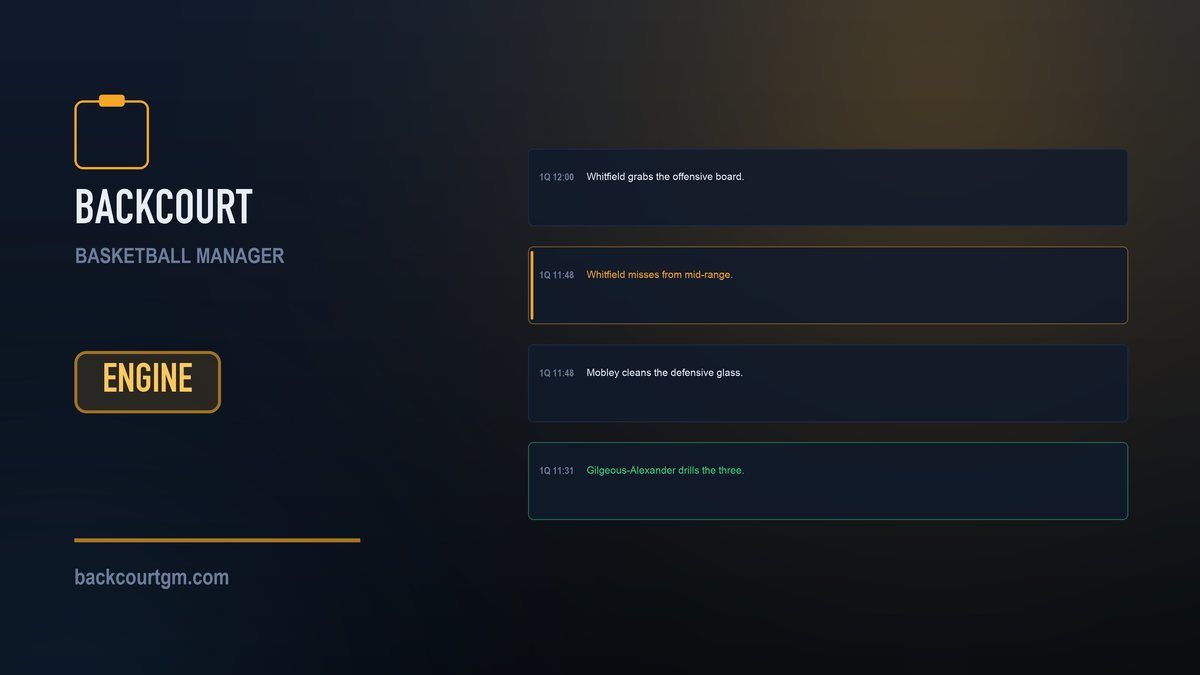
Most management games hand you a final score and a table. Backcourt plays the match out — ten markers on a live half-court, the ball moving along pass lines, and every action written into a feed stamped with the quarter and the game clock.
That feed is not decoration. It is the engine explaining its own decisions in plain language, in real time. Once you can read it, you stop being surprised by results.
What a feed line actually contains
A single row looks like this:
1Q 11:48 · IRW · Ivan Whitfield misses from mid-range.
Four pieces of information: the quarter, the game clock, which club, and the event. What makes it powerful is reading them in sequence rather than individually. One missed mid-range shot is noise. Four of them in ninety seconds, all from the same player, is a diagnosis.
The patterns worth recognising
Repeated offensive rebounds conceded
Your opponent keeps grabbing the offensive board. This is the clearest single signal in the feed and it almost always means the same thing: you do not have enough size on the floor right now, or your rim protector is off the court.
What to do: check who is actually playing. If you have gone to a small line-up to chase points, this is the bill arriving. Put your rim protector back on.
A run of mid-range misses from one player
Two causes, and you can distinguish them.
- Fatigue — check his ENR. Below 70 and this is exactly how it shows up, usually in the third and fourth quarters. The shots are the same; the legs are not.
- Role mismatch — if his energy is fine and this happens every week, he is taking shots his brief should not be generating. See roles explained.
Your defensive glass line appearing constantly
"Cleans the defensive glass" repeating is a good sign — your rim protector is doing his job. If you are still losing while this repeats, the problem is at the other end, not in your defence. Look at what your offence is generating rather than reaching for a defensive substitution.
Turnovers clustered in a single stretch
Three or four turnovers inside two minutes is usually a floor general operating under pressure — either fatigued, or facing a much stronger opponent. This is the highest-value moment for a timeout in the entire game.
Timeouts: seven a night, and most managers waste them
A timeout interrupts the opponent's rhythm and gives your side a small, temporary lift. That is a specific effect with a specific best moment.
Spend a timeout when the feed shows three or four consecutive possessions going the other way. That is a run, and a run is precisely what a timeout stops. Calling one at the start of a quarter, out of habit, spends a finite resource on nothing.
Seven is genuinely a lot. Managers who lose close games often finish with four unspent, having watched a 12–0 run happen in real time.
Speed: what to run and when
| Speed | Use for |
|---|---|
| 1× | Learning the engine, or a genuinely decisive game you want to manage properly. |
| 2× | A close game where you still want to react. |
| 4× | The sensible default. Fast enough to move, slow enough to notice a run. |
| 8× | A comfortable lead against a weak opponent. |
| Skip | Fixtures you do not care about. No penalty whatsoever. |
There is no hidden bonus for watching. The engine reaches the same outcome regardless. What you get from watching is information — and the ability to spend a timeout at the right moment, which the skip button cannot do for you.
Reading the court, not just the feed
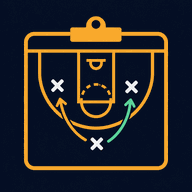
The half-court view carries information the feed does not. Player markers show position; the dashed line shows where the ball is going. Two things worth watching:
- Where your markers cluster. If four of your five are consistently outside the arc, you are not generating anything inside, and offensive rebounds will not be coming your way either.
- Who the ball actually reaches. If your best scorer's marker rarely receives a pass line, your floor general assignment is probably on the wrong player.
The habit worth building
Watch the third quarter. Not the whole game — the third.
Leads are lost in the third quarter more than anywhere else, because that is where fatigue from the first half starts to show and where the opposition's adjustments land. If you only ever pay close attention to twelve minutes of a match, make it those. Run the first half at 8×, drop to 2× for the third, and you will catch nearly every run that would otherwise have cost you the game.
Then check the post-game ratings — which are graded against expectation, not against the box score — and you will usually find the feed already told you exactly who had the night the marks say they had.
And for the statistics that tell you whether a good-looking box score was actually a good game, see why points per game lies.
Frequently asked
Does watching a match change the result?
No. The same engine decides the outcome whether you watch at 1x, run it at 8x or skip to the result. Watching changes what you learn, not what happens.
When should I call a timeout?
When the opposition is on a scoring run — typically three or four consecutive possessions going their way. A timeout interrupts that rhythm and gives your side a small temporary lift, which is wasted at the start of a quarter.
What does a run of mid-range misses mean?
Usually fatigue or a poor role fit. Check the energy of whoever is taking them; below 70 the fourth-quarter drop-off is real and visible in exactly this way.
Try it on your own club tonight
Backcourt is free on iOS and Android. Career mode works offline, and there is nothing to buy that makes your squad stronger.