Basketball explained
Wingspan in basketball: what an extra four inches of arm buys
Almost every NBA player has arms longer than he is tall, and the advantage is nearly identical at every position. What the extra length actually predicts, tested on 333 players.
Listen to any draft broadcast and you will hear more about length than about height. It sounds like scout-speak. It is measurable, and it is worth knowing what it does and does not predict before you use it to judge a player.
What actually gets measured
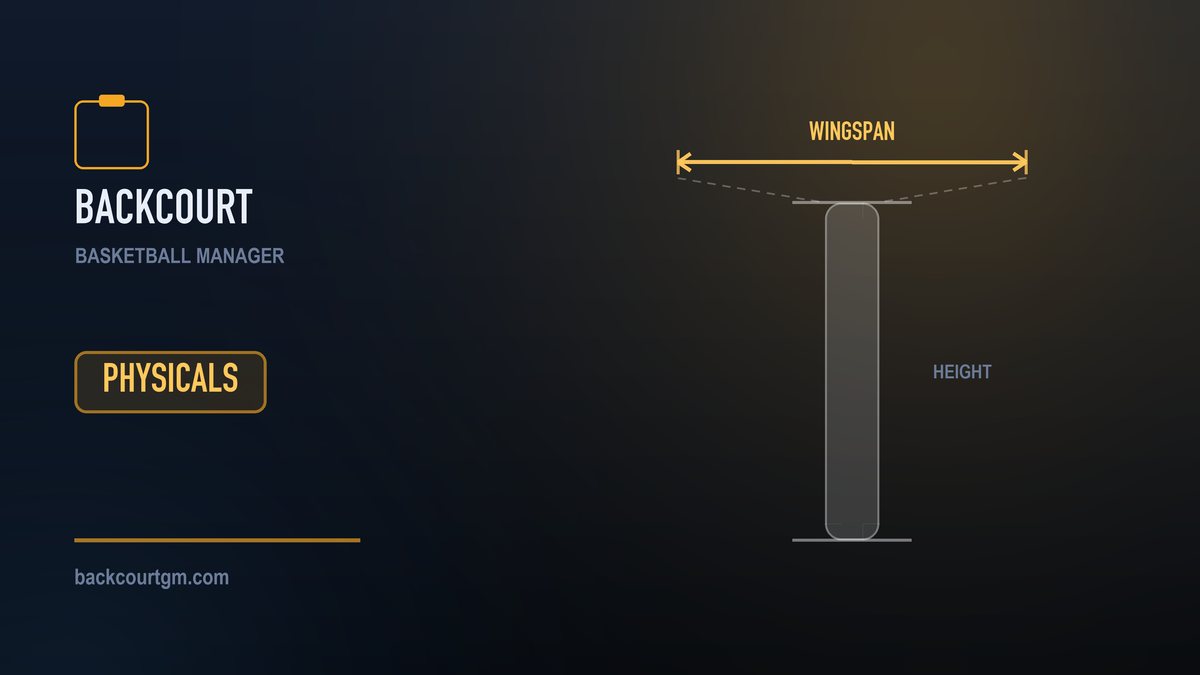
At the NBA Draft Combine, four separate numbers describe a player's frame, and the league's own glossary defines each one:
- Height without shoes — the honest version of the number on a roster.
- Wingspan — arms stretched horizontally, fingertip to fingertip.
- Standing reach — how high he reaches standing flat-footed. This is the one that decides whether he can contest a shot without leaving the floor.
- Hand length and width — measured too, and mentioned far less.
Long arms are not the exception. They are the rule
Here is the first surprise. In Backcourt's database, 333 players have both a listed height and a listed wingspan, and 95% of them have arms longer than they are tall. The average advantage is +10.4 cm, the median is +10 cm, and only 7 players measure negative. The average ratio is 1.052.
That matches the research. A 2018 study in the Journal of Anthropology of Sport and Physical Education measured nearly 3,000 NBA-scouted basketball players against a large US Army sample: basketball players averaged an arm-span-to-height ratio of about 1.06, the general adult sample about 1.03, and the entire human range runs from roughly 0.94 to 1.12. Elite players sit at the top of a narrow band rather than outside it.
The second surprise is that length is not a big-man trait. Across positions the advantage barely moves — every position in the pool averages arms 9 to 12 cm longer than its height, as the positions guide sets out position by position. What changes with position is absolute wingspan, which grows with height. The ratio is close to universal.
The extremes worth knowing
| Player | Combine year | Height | Wingspan | Difference |
|---|---|---|---|---|
| Tacko Fall | 2019 | 7′5.25″ | 8′2.25″ | +9″ |
| Doug Wrenn | 2003 | 6′5.75″ | 7′7.5″ | +13.75″ (ratio 1.18) |
| Mo Bamba | 2018 | 6′11.25″ | 7′10″ | +10.75″ |
| Kawhi Leonard | 2011 | 6′6″ | 7′3″ | +9″ |
| Kevin Durant | 2007 | 6′9″ | 7′4.75″ | +7.75″ |
| Mike Conley | 2007 | 5′11″ | 6′5.75″ | +6.75″ |
| Stephen Curry | 2009 | 6′2″ | 6′3.5″ | +1.5″ (ratio 1.02) |
| Zaccharie Risacher | 2024 | 6′8.5″ | 6′9.5″ | +1″ |
Tacko Fall is the only player ever measured at the combine with a wingspan above eight feet, per NBA.com's own list. The rest come from the league's published combine anthropometric tables. The last two rows are the useful ones: two players with almost no length advantage at all, one of them the best shooter who has ever lived.
So does it predict anything?
This is where the conversation usually stops being careful. Three honest answers, in ascending order of usefulness.
The peer-reviewed answer: yes, moderately. A 2018 study in the Journal of Strength and Conditioning Research (Teramoto and colleagues, 234 players from the 2010–2015 combines) found that height, standing reach, weight, wingspan and hand length all showed positive, medium-to-large correlations — r between 0.31 and 0.55 — with defensive box plus/minus. Of all the combine measurements, the length group was the one most associated with defensive value.
The deflating answer: the ratio itself barely matters. The same anthropology study that gave us the 1.06 figure found that arm-span-to-height ratio does statistically predict where a player is drafted — and explains less than one percent of the variation. Its own conclusion is that minor variation in body proportions confers a slight advantage at best.
The specific answer, tested on our own data. Wingspan correlates with blocked shots at 0.65 across those 333 players — which sounds decisive until you notice that height alone correlates at 0.62, and that height and wingspan correlate with each other at 0.83. The interesting question is what is left once you hold height constant:
| Extra wingspan, at the same height, tracks… | Correlation |
|---|---|
| Blocked shots | +0.30 |
| Rebounds | +0.13 |
| Defensive rating in Backcourt | +0.12 |
| Steals | +0.09 |
What length is actually for. Hold two players at the same height and the longer-armed one blocks more shots. He does not rebound meaningfully better, and he does not steal more. Length is about contesting the ball in the air, not collecting it — which is exactly why standing reach, not wingspan, is the measurement rim protection scouts care about most.
What this means in a manager game
In Backcourt, height and wingspan sit on a player's page as biographical facts. The match engine never reads them. What it reads is his defense, rebounding and speed ratings — and that is the right way round, because those ratings already contain whatever his arms produced on a real floor. A long-armed shot blocker shows up as a high defense rating, not as a hidden bonus.
Which is also the practical lesson for judging players in any GM game: the measurement is a clue about how a player achieves what he achieves, not an extra column of value on top of it. The attributes guide covers what the engine does use, and how much each rating is worth by position.
Frequently asked
How is wingspan measured in basketball?
At the NBA Draft Combine a player stretches his arms out horizontally and the distance is measured from fingertip to fingertip. Standing reach is measured separately: how high he can reach standing still, flat-footed. Height is recorded without shoes, and hand length and width are measured too.
What is a normal wingspan-to-height ratio?
For adults generally it is about 1.03, so arms a few centimetres longer than height. Basketball players measured by NBA scouts average about 1.06, and the full human range runs from roughly 0.94 to 1.12. Elite players are at the top of a narrow band, not outside it.
What is the ape index?
The same comparison written two ways: wingspan divided by height, where 1.0 is neutral, or wingspan minus height, where zero is neutral. Climbers popularised the term; basketball scouts usually just call it length.
Does wingspan actually make a player a better defender?
Partly, and less than the talk suggests. Peer-reviewed work on combine measurements found moderate-to-strong correlations between length and defensive box plus/minus. In our own database, once height is held constant, extra wingspan still tracks blocked shots but barely tracks rebounds or steals — length is about contesting shots, not collecting the ball.
Who has the longest wingspan in NBA history?
Tacko Fall, measured at 8 feet 2.25 inches in 2019 — the only player ever measured at the combine above eight feet. The most extreme ratio belongs to Doug Wrenn, who measured 6 foot 5.75 with a 7 foot 7.5 wingspan in 2003.
Does wingspan matter in Backcourt?
Not directly. Height and wingspan are biographical facts on a player's page; the match engine reads his defense, rebounding and speed ratings instead. That is deliberate — a long-armed player's advantage is already inside the ratings his real production earned.
Try it on your own club tonight
Backcourt is free on iOS and Android. Career mode works offline, and there is nothing to buy that makes your squad stronger.