Systems guide
Draft night, scouting, and the players who become a dynasty
Potential is shown as a range, not a number — and that range is the whole game. Here is when to pay for a report, what draft picks are really worth, and how to develop a prospect properly.
Every management sim eventually comes down to the same question: are you buying the present or building the future? Backcourt answers it with three connected systems — scouting, the youth intake, and the draft — and they are the systems most new managers ignore for their first two or three seasons.
That is understandable. None of them help you win this week. They are also the difference between a club that is good for one season and a club that is good for ten.
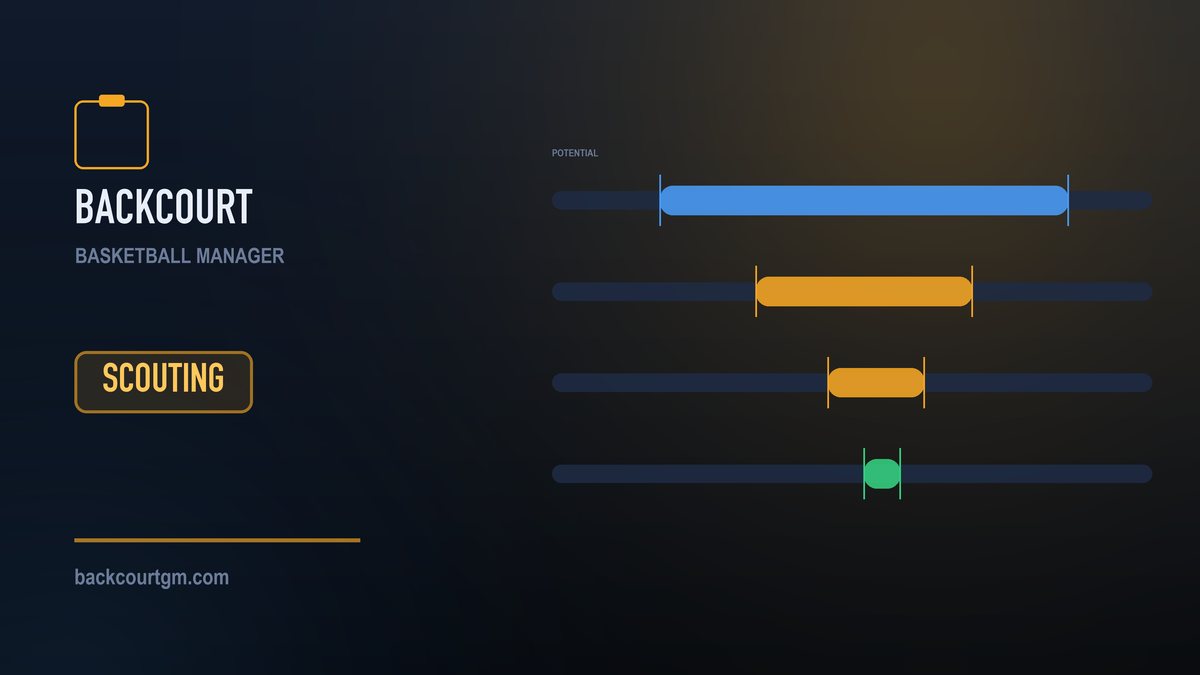
Potential is a range, and that is the point
Open the card of a draft prospect or a young player at another club, and his potential is a band, not a number. This is the single most important design decision in the whole scouting system, and it is easy to misread as vagueness.
It is not vagueness. It is honesty. Nobody in basketball knows what a nineteen-year-old will become, and a game that showed you a precise number would be removing the decision rather than modelling it.
Three things narrow that band:
- Scouting reports, which you pay for. Each one moves the estimate a step toward a firm number; a player you know nothing about takes three or four.
- Age and games played. The older a player is and the more league games he has behind him, the less his potential is a secret to anyone.
- Signing him. On your own roster his potential is shown exactly.
Read the width, not the top. A prospect with a band of 76–92 is not "a 92". He is a coin-flip with a very expensive downside. A prospect at 84–88 is a near-certainty. When your squad needs a contributor now, the narrow band is worth more than the exciting one — the wide band belongs to clubs that can afford to be wrong.
When a scouting report is worth paying for
Reports cost money, and money is tight. A simple rule: pay for a report when the answer would change what you do.
- Worth it: you are deciding whether to spend a high draft pick, or whether a prospect is worth a roster spot you could give to a useful veteran.
- Worth it: a rival is offering you a package for a young player and you do not know what you have.
- Not worth it: you already know you are taking whoever is best available, or the player is unaffordable regardless of what the report says.
Draft picks are currency
Picks can be traded on the trade desk alongside players and cash. That makes them a genuine financial instrument, and it opens two strategies that are both legitimate.
| Win now | Build | |
|---|---|---|
| Picks | Trade future picks for proven players | Accumulate picks, trade veterans for them |
| Roster age | Rises — you are buying peak seasons | Falls — you are buying seasons that have not happened |
| Wage bill | Climbs fast; proven players cost proven money | Stays low; rookies are cheap |
| Risk | A short window. Miss it and you have nothing left | Several poor seasons, and the lottery is weighted, not guaranteed |
The trap is doing neither: trading picks for players who are not quite good enough, ending up with an ageing roster, a full wage bill, no picks and no cap room. That is the position clubs get stuck in for four or five seasons, and it is reached one reasonable-looking trade at a time. When to commit to a rebuild, and how to run one without getting stuck, has its own guide: how to rebuild in a basketball GM game.
Draft lottery night
The lottery reveals balls one at a time, showing the odds and the pick movements as they land. It is theatre, and it is also information: you can see exactly how much luck you had rather than only where you ended up.
The practical consequence is that a rebuild is weighted, not guaranteed. Finishing bottom improves your odds; it does not buy you the first pick. Any plan that requires a specific pick is a plan built on a coin flip.
The youth intake and the academy
Every club receives an annual crop of prospects, and yours arrive with hidden potential. The academy facility is what improves that crop over time — which makes it one of the few upgrades whose value compounds rather than being consumed.
Most intake players will not make your rotation. That is normal and not a failure. You are looking for one player a season worth a roster spot, and occasionally an academy gem worth building around.
Development: training, drills and time
This is where most prospects are wasted, usually because managers look in the wrong place. In Backcourt a young player does not develop by playing minutes. He develops through three things, and all three favour youth and room below his potential:
- Weekly training. The gain is largest for players aged 22 or under, grows with the gap between current rating and potential, and is scaled by the gym level, the training intensity and the player's morale. Higher intensity is faster, but it costs energy and adds a small injury risk. Injured players do not train.
- Drills. Each player can do one drill mini-game a week; the better the score, the bigger the gain on the two attributes that drill works on.
- The off-season. Between seasons, players aged 25 or under grow on their own toward their potential, and the rare wonderkid grows about twice as fast. From 31, decline sets in.
So why play a prospect at all? Because minutes still decide three things. They show you what he actually is in a real game. They are how he builds form. And they keep him settled: a good player left on the bench can knock on the Locker-Room Door about minutes, and a broken promise costs morale, which slows his training. Those minutes come out of the 240 you divide every night, so spend them on purpose.
The blowout window. You are up twenty with six minutes left. The game is decided, your starters gain nothing by staying on, and every minute they sit is energy carried into next week. Give that time to a prospect you want to see in a real game — it is the cheapest look at him you will ever get.
Training focus and drills
The training focus decides which attributes a week works on, and each drill mini-game trains its own pair. For a prospect, point the focus at the attribute that gates his role rather than at whatever is lowest. A young rim protector does not need his playmaking fixed; he needs the thing his role is graded on.
Contracts: the part that catches people out
Players in their final contract year are badged in the squad list. Check that badge on your young players specifically, because developing a prospect for two seasons and then losing him is the most expensive mistake in this part of the game.
The end-of-season renewal desk is where this gets settled, and a prospect who has been playing and improving is cheaper to keep than one you have to buy back from the market later. See the transfer guide for how value and asking price behave — young players with high potential carry the widest gap between the two, which is exactly why other clubs will not sell you theirs.
A workable policy
- Read band width before band top. Narrow and good beats wide and exciting when you need results.
- Buy a report only when it would change a decision.
- Never trade a pick for a player who is not clearly better than what you have.
- Drill your best prospects every week, and use decided games to see them in real minutes.
- Point training at the attribute his role is graded on.
- Check final-year badges every season, especially on the players you are developing.
None of this wins you a game this week. It is what makes season eight better than season three.
The development mechanism itself is set out in how player development works, and the prospects currently worth chasing are listed in wonderkids.
Frequently asked
What does a potential range mean in Backcourt?
A prospect's ceiling is shown as a band rather than a fixed number, because nobody knows it yet. A wide band means genuine uncertainty. Scouting reports you pay for narrow it, and so do age and games played; once he is on your roster his potential is shown exactly. How close he gets to it is down to development: training, drills and off-season growth.
Are draft picks worth trading away?
Picks are tradeable assets on the trade desk, so they are a real currency. Selling future picks to win now is a legitimate strategy; doing it repeatedly leaves you with an ageing roster and no incoming talent, which is how clubs get stuck for several seasons.
How do you develop a young player?
Through training, drills and off-season growth, not minutes. Weekly training gains are largest for players aged 22 or under and grow with the gap to their potential, the gym level, the training intensity and the player's morale. Each player can also do one drill a week, and players aged 25 or under keep growing between seasons. Minutes matter indirectly: form comes from playing, and a good player left on the bench can lose morale, which slows his training.
Is the draft lottery random?
It is weighted. Draft-lottery night reveals the balls one at a time and shows the odds alongside the pick changes as they happen, so you can see both what you were entitled to expect and what actually landed.
Try it on your own club tonight
Backcourt is free on iOS and Android. Career mode works offline, and there is nothing to buy that makes your squad stronger.