Genre note
Basketball coaching games: where you make the calls during the game
Plenty of basketball management games let you build the team and then skip the part where a coach earns their salary. Here is what real in-game coaching looks like, and how to spot it.
Plenty of basketball management games let you do the general manager's job — sign the roster, balance the budget, run the draft — and then hand the actual game to a results screen. That can be a perfectly good game. It is just not a coaching game, and if what you wanted was to stand on the sideline and make the calls, it will feel like watching someone else coach your team.
Here is what separates the two, the decisions a real coaching game has to give you, and how to tell before you install.
General manager or coach?
In professional basketball these are two different jobs, usually held by two different people, and games tend to lean towards one of them.
| General manager | Head coach | |
|---|---|---|
| Works on | The roster, over seasons | The next 48 minutes |
| Main decisions | Signings, trades, contracts, the draft, the budget | Rotation, matchups, timeouts, adjustments, late-game plays |
| Judged on | Whether the roster is good enough | Whether the roster plays up to it |
| In a game, looks like | Menus, markets and a season calendar | A match you can pause and change |
The best management games give you both, because the jobs feed each other. A GM who signs three point guards makes the coach's rotation impossible, and a coach who burns out the star makes the GM's contract look like a mistake.
The decisions that make it a coaching game
Substitutions and minutes
A basketball game is 48 minutes across five positions — 240 player-minutes to share out. Deciding who plays and for how long is the core coaching decision, and it only matters if players tire. Look for an energy system that drains with minutes and visibly costs you late in games. Without one, playing your best five for 48 minutes is always correct and there is nothing to coach. Our rotation guide goes deep on this.
Timeouts
A timeout is a scarce resource with one best use: stopping the other team's run. A coaching game should give you a limited number and make the effect visible, so that spending one in the middle of an 8–0 stretch is a decision rather than a menu button.
Foul trouble
Your best player picks up a fourth foul early in the third quarter. Sit him and lose his minutes, or leave him on the floor and risk losing him for the fourth? It is one of the most common real coaching dilemmas, and a game that tracks fouls per player can put it in front of you.
Tactical adjustments
The ability to change how the team plays during a game — the pace, where the offense goes, how hard you pressure the ball — so that what you see happening can change what you do next.
The final possessions
Down two with a minute left: go for the tie at the rim, the win from three, or foul to stop the clock? Late-game decisions are where a coach earns their reputation, and where a results-screen game has nothing to offer at all.
How to tell whether a game really lets you coach
- Can you pause the match and change something? If the only controls are play and skip, it is a GM game.
- Can you substitute mid-game? Not just set a rotation before tip-off.
- Are timeouts limited? Unlimited timeouts are not a decision.
- Does fatigue exist? Without it, the rotation is cosmetic.
- Can you see why something happened? A play-by-play feed or a visible court lets you react to a run instead of discovering it in the box score.
Coaching in Backcourt
We built Backcourt around both chairs, so here is what the coaching side actually contains:
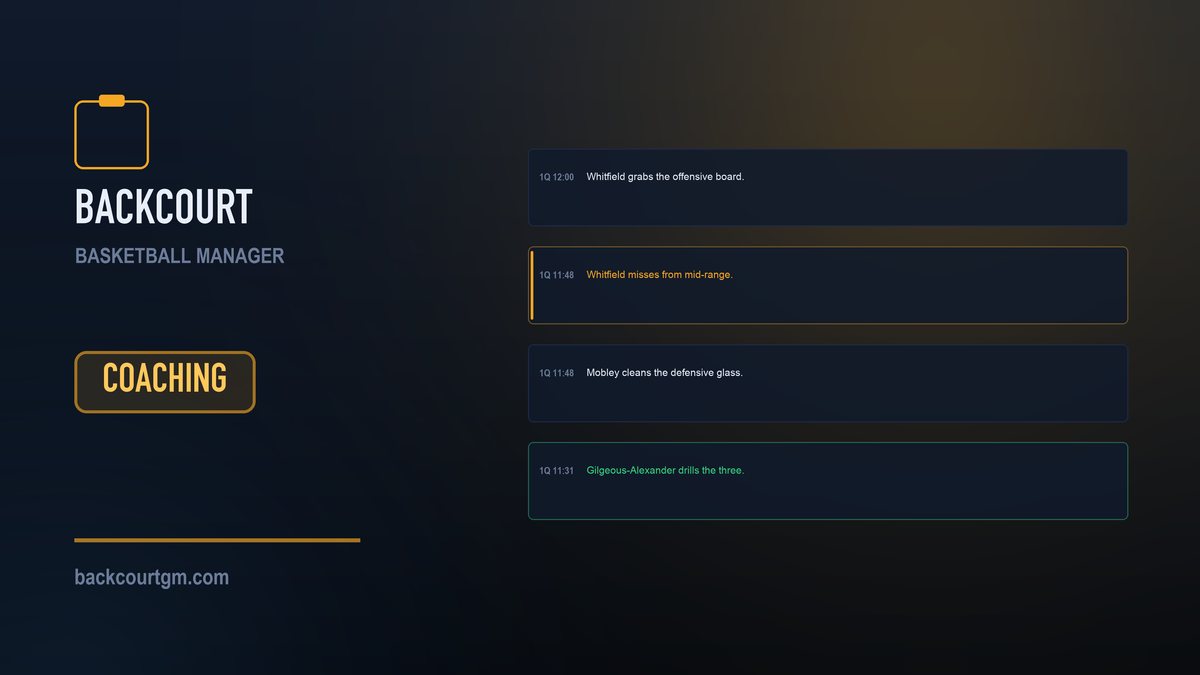
- A live match engine. Possessions play out on a court with a commentary feed stamped with the quarter and clock, at 1× to 8×, or skipped when you only want the result.
- Seven timeouts a night, with a fresh-defense indicator on the pulse strip afterwards so you can see the effect.
- Coach moments. The game pauses for your call when the opponent goes on a run, a player gets into foul trouble, fatigue sets in, or crunch time arrives. They can be switched off in Settings.
- Tap a player on the court for a quick card: sub him out, make him the offensive focus, protect him, or lock the opponent.
- Crunch time: intentional fouls, last-second plays and foul-trouble protection, plus a late-game plan — give it to the star, hunt threes, or attack the rim.
- Tactics presets and A/B/C sets you can switch between, covered in the tactics guide.
- Energy that floor time burns, so the rotation decision is real every night.
Skipping to the result also offers to let you play the finish when a game is close, so even a quick season can still put the last minutes in your hands. The play-by-play guide explains how to read a game while it is happening.
What coaching games still leave out
To be honest about the limits: very few games let you design individual plays or draw up sets, and Backcourt does not either. What coaching games — ours included — model is the level a head coach mostly works at during a game: who is on the floor, how the team plays, when to stop a run and what to run late. If drawing plays on a whiteboard is the part you want, you will not find it here.
The short version
- A GM game builds the roster; a coaching game runs the match. The best do both.
- Look for fatigue, limited timeouts and mid-game substitutions. Without them there is nothing to coach.
- Pause and change is the real test. If you can only play or skip, it is a GM game.
- Late-game decisions are where a coaching game proves itself.
Frequently asked
What is a basketball coaching game?
A game where you make the decisions a head coach makes during a match — substitutions, timeouts, tactical adjustments and the plan for the final possessions — rather than only building the roster beforehand.
What is the difference between a coach game and a GM game?
A GM game is about the front office: signings, contracts, trades, the draft and the budget. A coaching game is about the 48 minutes: who is on the floor, when to stop a run and what to run late. Many management games are mostly GM games with a results screen.
Can you coach during the game in Backcourt?
Yes. Matches play out possession by possession, and you have timeouts, substitutions and tactical changes. Coach moments pause the game when an opponent goes on a run, a player gets into foul trouble, fatigue sets in or crunch time arrives, and they can be switched off in Settings.
Do basketball coaching games let you design plays?
Very few do, and Backcourt does not. Most coaching games work at the level a real head coach mostly works at during a game: the rotation, the tactical style, who gets the ball and what to run in the final possessions.
Try it on your own club tonight
Backcourt is free on iOS and Android. Career mode works offline, and there is nothing to buy that makes your squad stronger.